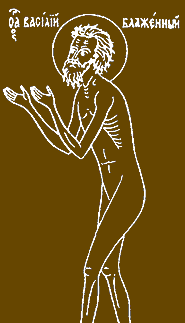
When analyzing Vasilenko`s "Little Fool" we will both approach it as a work of literature and explore the ways in which it endorses the paradigm of foolishness in Christ. You will find below questions that are important for the literary analysis of this work.
Analysis of a literary work:
1. Narration: Who tells the story? What is the narrator`s attitude toward or relationship with the events that he/she describes? What is the narrator?s attitude toward the various characters? Does the narrator participate in the story or give evidence of a particular, personal relationship with it? How does the narratorial point of view affect the story?
2. Characterization (method for describing characters): What techniques are used to describe the characters? Action or behavior? Manner of speaking? Appearance? Which details tell us what? Are the techniques used for characterization the same for all characters? What is the relationship between the various characters and the narrator? Does the story reveal any unsuspected truths about its characters? Any previously hidden qualities? Do the characters initially impress us as being something different from what they turn out to be?
3. Narrative structure and time/plot sequence: How is the story built?What tense is the story told in? Do the events unfold in the order that they occur or have parts of the story been taken out of sequence? Does the story sometimes jump forward or backward in time? How do these changes advance the plot?
4. Uses of nature/environment: What is the story`s setting? Does it take place in the country, city, and/or a provincial town? Is there an emphasis on the difference between these different spaces? Is the environment benevolent and hospitable or is it unpleasant and harsh? Is there an emphasis on the environment being either "natural" or "unnatural"? How does the environment provide a backdrop for the narrative? Does it underline certain aspects of the described personal relationships?
5. Realism: In what ways might this story be said to be realistic? Is there a lot of accurate descriptive detail? How does the story present the thoughts, motivations, and emotions of the characters? Does the speech of the characters mimic real human speech? In what ways is the story unrealistic? Do the realistic or unrealistic aspects of the story serve a particular artistic purpose?
6. Class/national/race relations: Does the story address relations between classes, nations, and/or races? Are there conflicts or important differences between these? Are particular qualities seen to inhere in one group but not the other? What distinguishes one character or group of characters from another? What is the attitude of the narrator and other characters towards these differences?
7. Gender relations: How does gender function in the story? Do the male and female characters remain within the limits of traditional roles or do some of them behave differently? Is such different behavior seen as problematic? Is it rewarded or punished? What is the spatial relationship between the male and female roles in the story? Do both have access to spaces inside the home? Do both have access to outdoor activity, travel, adventure?
8. Moral issues: How does the text address (or fail to address) particular moral issues? Which kinds of values are seen as important? Which values are positive and which are negative? Does the story advance clear notions of good and evil? Do some characters behave more morally than others? How does the text deal with human error, dishonesty, weakness? What is the moral position of the narrator? Does the story suggest or provide a moral position for the reader?